do.so.now
← All tools
A LITTLE HELP EXPLORING OUR WORLD

Geography HelperDiscover places.
Understand connections.

Type a question, upload a picture, or take a photo.
Explore places, people and environments with maps, evidence and clear explanations.

Maps and directionsWeather and climatePopulation and settlementSustainability
Checking Geography Helper availability…
01 · YOUR QUESTION

What are we working on?

Include place names, dates, map labels and any source details.0 / 8000

Explain physical patterns, resources, sustainability, settlement and quality of life.

Topics are a learning guide. Courses vary by school and region.

Your question and selected photo are sent to the AI service only when you choose Read or Solve. They are not saved to a public gallery.

TRY A WORKED EXAMPLE
Examples are prepared lessons, not AI-generated answers to your question.
02 · MAKE IT MAKE SENSE

Your step-by-step guide

Start with the question.
We’ll help with the next step.

Read the map, recognise patterns, connect people and environments, and support your answer with evidence.

01

Bring your question.

Type the full problem or photograph a clearly written page.

02

Check what was read.

Correct a blurry symbol or missing number before asking for a solution.

03

Learn the method.

Connect places, people, environments and evidence to explain geographic patterns.

What can I ask?

Explore maps, landforms, climate, resources, communities, population, sustainability, hazards and world issues. Include the full question and any map, data or source details. For current statistics, provide a dated source.

If a question is unclear or needs information, the solver should ask you to clarify rather than guess.

Worked example (English)

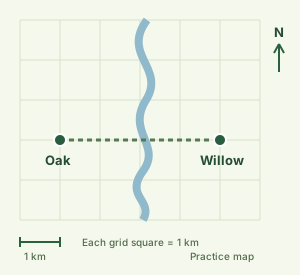
On the fictional practice map, Oak and Willow lie on the same horizontal grid line. Willow is four squares to the right of Oak. North is at the top and each square represents 1 km. What is the direction and straight-line distance from Oak to Willow?

Willow is 4 km east of Oak.

  1. Read direction first

    The north arrow points towards the top of the map. East is therefore to the right. From Oak to Willow you move right.

  2. Use the map scale

    The towns are four full grid intervals apart. Each interval represents 1 km.

    \(d=4\times1\,\text{km}=4\,\text{km}\)

  3. State what the result means

    The answer is a straight-line distance. A real route could be longer if roads curved or required a detour.

Going back from Willow to Oak would be 4 km west. The distance is unchanged, but the direction reverses.

Examples are prepared lessons, not AI-generated answers to your question.